How do we create sensory regulation spaces with a limited budget and very often limited spaces?
With thought and creativity it is possible, as demonstrated by Hawthorns School, Tameside. They have created within their classrooms both a ‘gym’ and a ‘spa’ space. As well as having larger spaces within school, they recognise the importance of in-class provision in order to enable proactive regulation. I am hoping this might give you some inspiration for your setting and realise that you can create sensory regulation spaces with limited budgets and limited spaces.
Rachel Kay, deputy head, has kindly shared how they set up these spaces and the equipment that they used in the school. This is an example for you to see, but it is important that you carry out your own risk assessment within your setting for any equipment that you install and use.
In Class Regulation Spaces : The Gym
Purpose: To maintain sensory regulation in the classroom.
Movement spaces can be used to support learners pro-actively eg not when highly dysregulated. Learners may also use these freely through the class day to self-regulate.

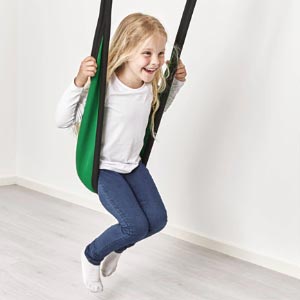
This gym space has been created by completing clearing out the cupboard in the classroom. The school caretaker has created a system to suspend the swings from the walls. Apart from the padding, the rest of the equipment was purchased on Amazon for a total cost of £ 150.
Hammock £ 12.99
Sound and light machine £ 21.98
Extra large roller £65.99
Yoga ball £ 14.99
Trampette £34.99
Retreat : The Spa
Purpose: To maintain sensory and emotional regulation in the classroom.
Spaces that are low stimulus that can be used when pupils are becoming dysregulated, or need a break , but are able to co/self regulate within the classroom.

Small Regulation Space Out of Class
In addition to the in class regulation spaces, they have also created a regulation space using a small room off the main corridor in one section of the school.
Purpose: To support sensory & emotional regulation more intensely, on a 1-1 basis.
These provide movement opportunities but also an element of retreat . These can be used to support regulation ‘in the moment’ where learners need a lower stimulus space to go to – but are not intensely dysregulated. The end goal is that learners ask to go to these spaces when they recognise they need a break.